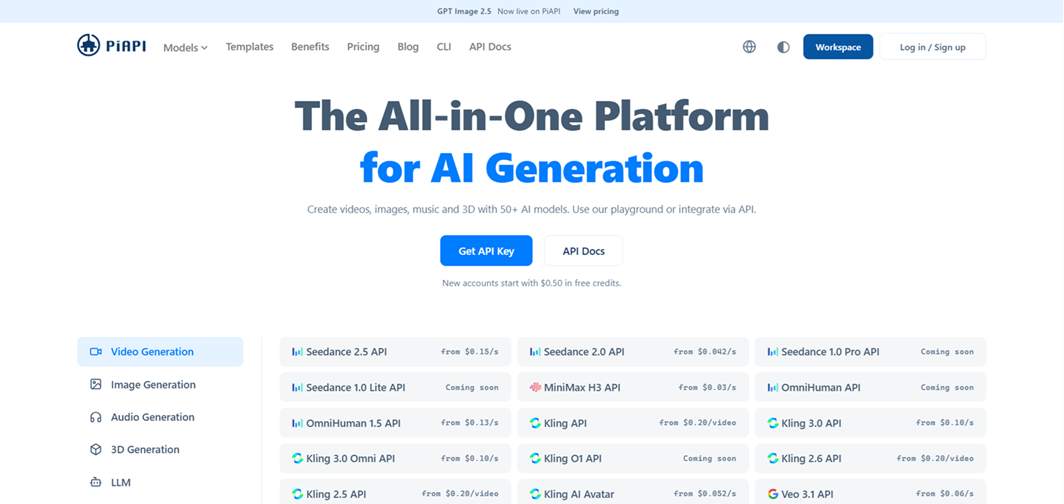
PiAPI is a developer-focused platform for adding generative AI capabilities to applications without having to build a separate API connection for every model or service. It brings image, video, audio, 3D, and language models together under one ecosystem, giving developers a single place to experiment with different AI technologies and integrate them into their products. Its current catalog includes models for tasks such as text-to-video, image-to-video, text-to-image, image editing, music generation, speech, avatars, 3D creation, and conversational AI. The platform lists models from providers and projects including ByteDance, Google, OpenAI, Kling, Alibaba, MiniMax, Anthropic, DeepSeek, Black Forest Labs, and others. One of PiAPI's more practical features is its Unified API structure. Instead of learning a completely different request and response format for each model, developers can use a common task-based system to create a job and retrieve its result. The request generally specifies the model, task type, and required inputs, while webhooks can be used when applications need to receive updates as tasks are completed. This approach can make it easier to test different models or replace one model with another as a project evolves.
It also offers a playground for experimenting with its available models, alongside API access for integrating those capabilities into software and automated workflows. Its model selection is particularly broad for generative media, with options for popular video-generation systems such as Seedance, Kling, Veo, Wan, Hailuo, Luma, and others, as well as image-generation and editing models including FLUX, GPT Image, Seedream, and Qwen Image. Developers can work with PiAPI through its API endpoints, and the platform also provides a command-line interface for running multimodal AI models from a terminal or automation workflow. Its pricing generally follows a usage-based model, with individual models carrying their own rates depending on the type of generation or processing involved. For teams considering a PiAPI alternative, the important areas to compare include the available model catalog, API structure, pricing, response times, supported media types, reliability, and how easily models can be switched within an existing application. PiAPI is therefore a good fit for developers who want a centralized way to access a variety of generative AI models while keeping the integration layer relatively consistent across different services.



.webp)