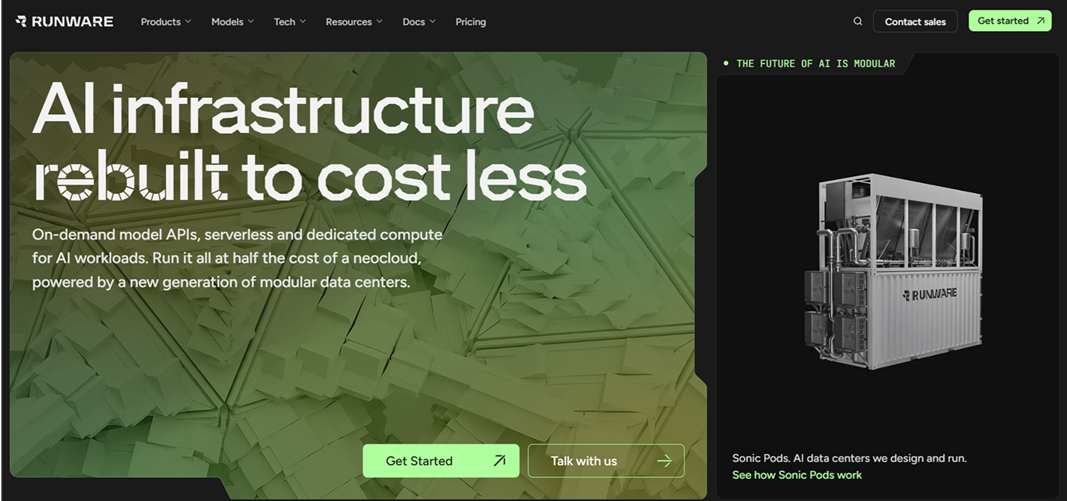
Runware is an AI infrastructure platform built for developers and businesses that want to integrate generative AI into their own products without managing a separate connection for every model or provider. It brings a broad collection of AI capabilities together behind a unified API, making it possible to build applications that generate images, create videos, produce audio, process text, and work with 3D assets through a common interface.
One of its main advantages is model flexibility. Developers can choose from a large catalog of open-source and proprietary models and switch between them without rebuilding their entire integration. This is particularly useful for products that need different models for different jobs, such as generating marketing visuals, editing photographs, creating short video clips, synthesizing speech, or powering AI-assisted content tools. Instead of maintaining multiple provider-specific integrations, teams can manage these workflows through a shared API structure. Image generation and editing are important parts of the platform. Applications can use text prompts to create images, transform existing visuals, edit selected regions, extend image boundaries, and apply more advanced controls. Support for techniques such as LoRAs, ControlNet, and IP-Adapters gives developers additional options when building workflows that require greater control over style, composition, or visual consistency.
It also supports video generation workflows, including text-to-video and image-to-video, alongside audio generation, language models, media analysis, and image-processing utilities. Depending on the selected model, developers can build features for voice generation, lip synchronization, upscaling, background removal, transcription, content moderation, and other media-related tasks. This broad coverage makes It relevant to AI video applications, creative platforms, ecommerce tools, and automated content production systems. For production use, the platform supports REST and WebSocket connections, official SDKs, asynchronous processing, webhooks, and batch requests. These options help developers manage longer-running generation jobs, process multiple tasks, and integrate results into existing application workflows. Teams can also explore its serverless infrastructure to deploy their own code and models rather than relying exclusively on hosted third-party models.
It uses pay-as-you-go pricing for its managed model APIs, with costs varying by model and generation settings. This can be attractive for projects that prefer usage-based spending over a fixed subscription, although high-volume applications should estimate costs carefully. When evaluating a Runware alternative, compare model availability, generation speed, output quality, API reliability, customization, deployment options, documentation, and per-task pricing. Runware is particularly suited to developers who want broad AI model access and the flexibility to build multimodal features into their own applications.



.webp)