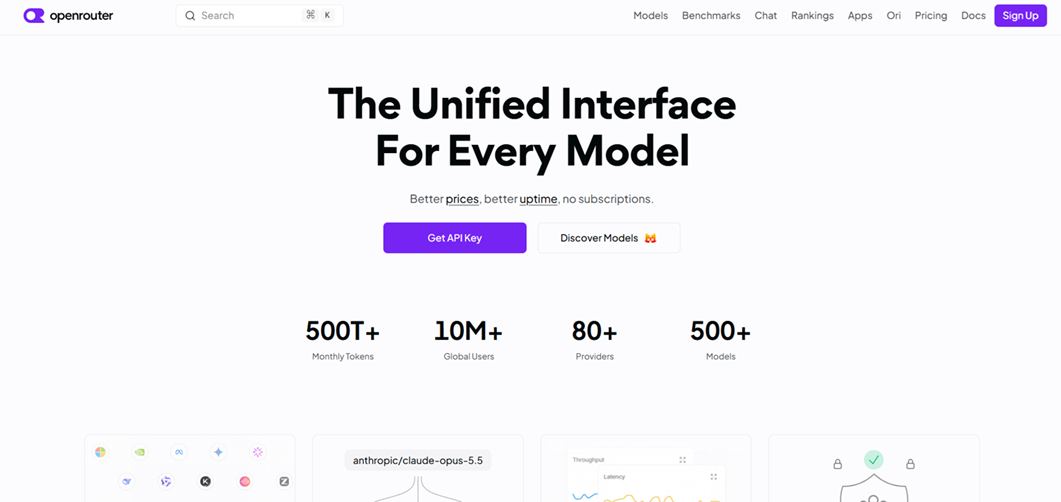
OpenRouter is an AI platform that gives developers a single API for accessing models from a wide range of AI providers. Its main appeal is flexibility: instead of building an application around one model or maintaining separate integrations for different providers, developers can use it as a common interface and switch between models as their requirements change. The platform provides access to hundreds of models covering conversational AI, reasoning, coding, vision, image generation, and other use cases, with options from providers such as OpenAI, Anthropic, Google, Meta, Mistral, DeepSeek, xAI, Qwen, and many others. This broad selection makes it useful when developers want to compare different models or choose between them based on quality, speed, context length, and cost. One of the platform's most useful features is its routing system. When a model is available from multiple providers, it can route requests between available providers based on factors such as availability, performance, and pricing. Developers can also configure routing preferences when they want more control over which providers handle their requests. This can help applications remain more resilient instead of depending entirely on one provider or endpoint.
It uses an API format that is compatible with the OpenAI Chat API, which means developers can often connect existing applications with relatively few changes. It also supports features such as streaming responses, tool calling, structured outputs, multimodal inputs, and model-specific parameters for supported models. Alongside its developer tools, it provides a model directory where users can compare available models and see information about their capabilities, context windows, pricing, and provider availability. This makes the platform useful not only for deploying AI applications but also for researching which model is appropriate for a particular task. Pricing is generally based on the underlying model and provider, with users paying according to the amount of input and output processed. Because multiple models can be accessed from the same account, teams can experiment with different options without setting up a separate billing relationship for every provider. For businesses considering an OpenRouter alternative, important factors include the number and type of models available, routing controls, provider coverage, API compatibility, pricing, reliability, and the level of control offered over inference. OpenRouter is particularly attractive to developers who value choice and want the freedom to change AI models without redesigning the core architecture of their application every time a new model becomes available.





.webp)