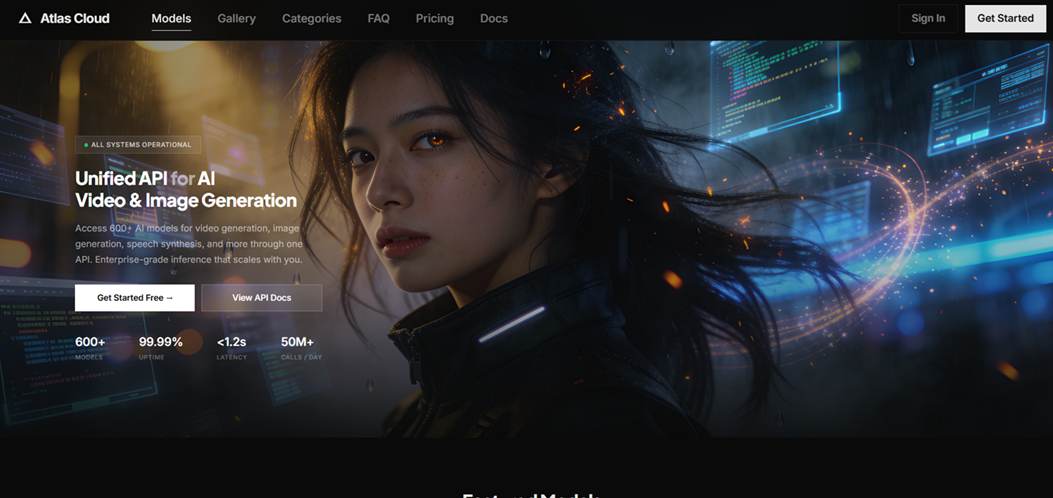
Atlas Cloud AI is built for teams that want to work with different AI models without creating a separate integration for every provider. The platform brings hundreds of models under one API, covering everything from large language models and image generation to video, audio, and 3D applications. This makes it particularly relevant for developers building AI features into SaaS products, creative applications, automation tools, and other software products. Rather than locking a project into a single model or provider, developers can choose from models such as OpenAI, Google, DeepSeek, Qwen, ByteDance, MiniMax, Black Forest Labs, and others, depending on the type of task they need to handle. It also supports several familiar API formats, including OpenAI, Anthropic, and Google Gemini-compatible protocols, which can reduce the amount of work involved when moving an existing application to the platform. Beyond text-based AI, the platform has a growing selection of generative media models for creating images and videos, including options for text-to-image, image-to-image, text-to-video, and image-to-video generation. Models such as Seedance, Kling, Veo, Wan, Seedream, FLUX, and Hailuo are available for different creative workflows, giving developers the flexibility to test multiple approaches instead of relying on one model. Another practical aspect of Atlas Cloud is its usage-based approach. Teams can use the models they need and pay according to their usage rather than setting up separate accounts and billing arrangements across multiple AI providers.
The platform also includes developer-oriented features such as asynchronous processing, webhooks, API keys, CLI access, and MCP support for different integration requirements. For a developer, this can make experimenting with new models considerably more straightforward, especially when a project requires different models at different stages of development. However, teams looking at an Atlas Cloud AI alternative may prefer a platform with a stronger focus on a particular area, such as AI video creation, image generation, model deployment, or a more visual creator experience. The right choice will depend on the application's requirements, the models needed, expected usage, API compatibility, pricing, and the amount of control the development team wants. Overall, it is best suited to businesses and developers looking for a central access point to a broad selection of AI models rather than managing numerous individual model integrations.



.webp)